







The aim of this guide is to explain in a simple way all the available internet options in Greece and help you quickly choose the solution that suits you for your holiday.
The internet is an indispensable part of every trip today. In Greece, it is used by almost all tourists – for navigation, communication, booking, payments and sharing content.
- Although Greece has good mobile network coverage, choosing the right connection method can be confusing, especially for first-time travelers.
In this guide, based on our long-standing experience in the field and thousands of your inquiries, we explain the internet options available in Greece, how they work in practice, and how to choose the one that best suits your way of traveling.
- Updated: January 2026.
What internet options are available in Greece?
Tourists in Greece most commonly choose between mobile internet (eSIM or local SIM card), roaming from their home country, and Wi-Fi networks. For most travelers, mobile internet represents the most stable solution, as it provides connectivity throughout the day without relying on the availability of Wi-Fi networks.
Mobile internet (eSIM and SIM cards)
If you want internet that works everywhere in Greece - at the beach, while driving, and outside accommodation - mobile internet is the most reliable solution. The difference between eSIM and a local SIM card usually comes down to activation speed and convenience.
Roaming from your home country
Within the EU, it often works without additional costs, but the rules depend on the operators and tariffs. Roaming has become much cheaper with Serbian operators now. However, you should thoroughly check the roaming prices before your holiday to avoid unpleasant surprises. The speed and amount of internet may be limited.
- Note for tourists from Romania and Bulgaria: Although you are in the EU zone (Roam Like At Home), your operators often apply a “fair usage policy.” This means that in Greece, you may have significantly less internet than at home, or your speed may drastically decrease after consuming a few gigabytes. Local solutions or dedicated traveler eSIMs provide full speed without these limitations.
Wi-Fi networks in Greece
Available in hotels, apartments, restaurants, and cafes, but the quality and stability vary. During the season, when more guests are using the same network, the internet can be slow, which especially affects tourists who work online or travel with teenagers.
One of the most common requests when asking us for accommodation recommendations is precisely - good internet in the accommodation.
- Nothing ruins a vacation like trying to send an important email or post a picture on social media while 50 people in the villa are trying to do the same through one router.
eSIM in Greece – how it works and who it’s for
In practice: eSIM allows you to have mobile internet in Greece without going to a store and without replacing a physical SIM card. All you need is a compatible phone and installation via a QR code, after which the internet is ready to use.
In Greece, eSIM works the same as in other European countries - it connects to local mobile networks and provides stable mobile internet during your stay. eSIM is particularly convenient for:
- tourists who want internet as soon as they arrive,
- those who don’t want to change a physical SIM card,
- travelers who use navigation, apps, and online services throughout the day.
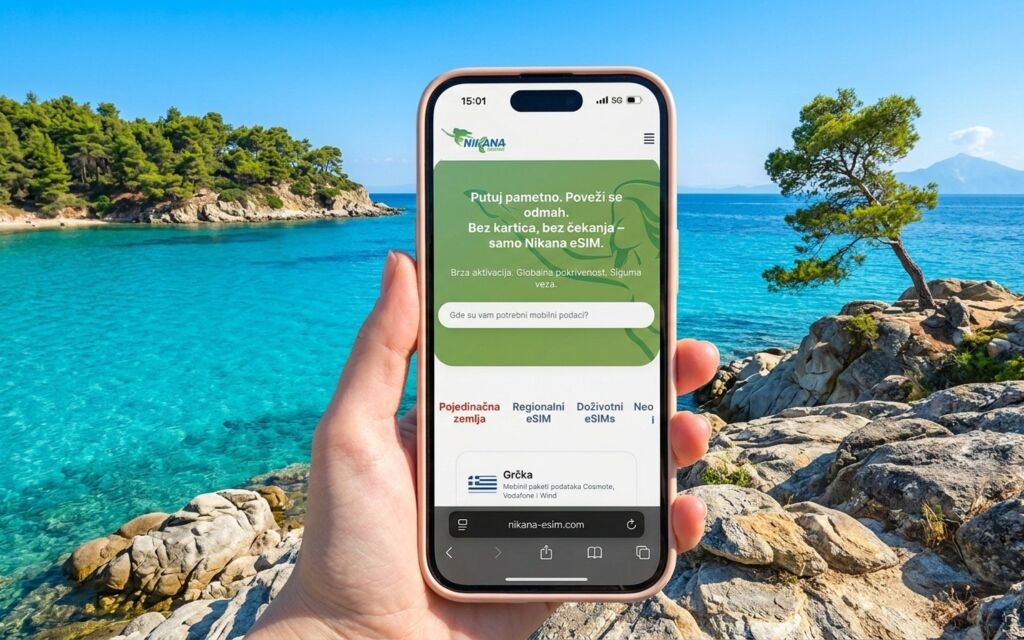
One of the major advantages of certain eSIM providers, such as Nikana eSIM, is that you are not tied to just one operator.
- While a local SIM card forces you to use only their network (e.g. Cosmote only), with a quality Nikana eSIM we can always choose the strongest signal between all three Greek operators (Cosmote, Vodafone, Nova). This is crucial for stable internet on islands or in secluded bays.
A detailed explanation of how it works, how it is installed and how it is used can be found in a separate article: How eSIM works in Greece.
Local SIM card in Greece – what you need to know
Buying a local SIM card is still an option for tourists, but with certain limitations. SIM cards are most commonly purchased at mobile operator stores or in larger cities and tourist centers.
- Personal documentation is usually required for purchase, and activation is sometimes not immediate.
- Additionally, communication in stores can be challenging if you do not speak Greek or English.
A local SIM card may be suitable for a longer stay, but for shorter trips, it often requires more time and organization than it initially seems.
eSIM or local SIM card in Greece
When comparing from a tourist’s perspective, the difference usually comes down to convenience and speed of use.
- eSIM is activated digitally and does not require physically swapping a card,
- while a local SIM card involves going to a store and additional steps.
- On the other hand, a local SIM card can be a solution for those staying longer or wanting a traditional way of connecting.
- A detailed comparison of all advantages and limitations can be found in the text:
eSIM vs local SIM card in Greece
How much internet is enough for a holiday in Greece
Internet consumption depends on usage. Tourists using the internet for navigation, messages, and occasional browsing consume significantly less than those watching videos or working online. In practice, the difference is substantial between:
- occasional use throughout the day,
- constant use of multiple applications,
- sharing internet with other devices.
To realistically assess your needs, check the guide:
Internet in Greece for families with children
Family trips have specific requirements. Multiple phones, tablets, and often the need for stable internet throughout the day make reliability more important than just the price. Parents typically use the internet
- for navigation, communication, and organizing the day,
- while children use apps, videos, and games.
Therefore, it is essential to consider a solution that can support multiple devices without interruptions in advance.
- More on this topic can be found in the text:
eSIM for families with children
Common internet problems in Greece and how to solve them
Common internet problems in Greece and how to solve them
While the internet in Greece is generally reliable, various issues can arise:
- eSIM – difficulties with activation, APN settings, or phone compatibility.
- Local SIM cards – waiting in stores, the need for personal documentation, slower activation.
- Wi-Fi – slow or unstable internet in hotels, restaurants, and beach bars when many guests are using the same network.
- Roaming from your home country – limited data or higher costs if tariffs are not checked before.
Tips for quick solutions:
- Check APN and install eSIM profiles.
- If using a local SIM, prepare documents and plan time for purchase.
- For Wi-Fi, check signal availability or use mobile internet as a backup.
- With roaming, check tariffs and limits in advance.
For specific solutions and detailed instructions, see the following texts:
- Which SIM card to choose in Greece
- Common issues with eSIM and solutions
- APN settings (iOS / Android)
- Does eSIM work on all phones?
Wi-Fi in Greece – how reliable is it for tourists
Wi-Fi is widespread in Greece, especially in hotels, apartments, and hospitality establishments. However, the quality of the connection depends on the
- location,
- number of users, and
- infrastructure.
During the tourist season, Wi-Fi in accommodations can be slower, and public networks are not always secure for sensitive activities like online payments or logging into important accounts. Therefore, Wi-Fi is mainly used as a supplement, not the sole solution for internet during your stay.
Internet in transit: From home to the beach (Serbia – North Macedonia – Bulgaria – Greece)
Many travelers from the Balkans to Greece pass through several countries, through North Macedonia or Bulgaria to Greece. Using navigation or listening to music during transit can lead to unexpected costs or being “cut off”.
- Solutions like Nikana eSIM are practical because they cover the entire route.
- The internet works while passing through North Macedonia or Bulgaria, and remains active once you cross the Greek border, without the need to change any settings.
- The same applies to other destinations, read more in the text:
Nikana eSIM – internet as soon as you cross the border in over 150 countries worldwide
Practical notes before traveling
Internet in Greece is easily accessible, but the right choice depends on your needs, travel style, and usage habits. Understanding the differences between eSIM, local SIM cards, and Wi-Fi networks helps you avoid unpleasant surprises and stay connected throughout your stay.
For each topic in this guide, there are detailed texts explaining specific situations and solutions. When you are informed, the decision is simpler - and the journey more relaxed.
Frequently asked questions about internet in Greece
Does eSIM work in Greece without roaming? Yes. eSIM connects to local Greek networks and does not use traditional roaming from your home country. Can I keep my phone number? Yes. eSIM is used alongside your existing number for calls and SMS. Does eSIM work immediately upon landing or crossing the border? In most cases, yes, as soon as your phone connects to the local network. Is Wi-Fi sufficient for a holiday? Wi-Fi can be useful as a supplement, but it is not as reliable as the only solution, especially during the season.
Explore Greece with Nikana
Discover tips, authentic experiences, and insider info to make your holiday unforgettable.
Find your perfect stay Browse 3,000+ accommodations for families, couples, or solo travelers. See all options.
Instant Internet Get online the moment you cross the border with Nikana eSIM – simple setup via barcode, instant coverage worldwide. Install now.
Follow & connect Stay updated with exclusive offers, discounts, and travel tips:
More info & travel guides: nikana.gr – your ultimate guide to Greece.


