












All about fines, P40 sign, and document return procedure
Losing or having your driver’s license confiscated while on vacation in Greece is one of the most unpleasant situations that can happen to drivers. The traffic police in Greece is extremely strict when it comes to illegal parking and endangering traffic, so a monetary fine is often not the only consequence of a violation. Below you will find out when the police have the right to confiscate your driver’s license and license plates, what the famous P40 sign signifies, and what the procedure for returning documents looks like.
When can the Greek police confiscate a driver’s license and plates?
Subsidiary regulations and the Greek Traffic Safety Code (K.O.K.) provide for severe sanctions for drivers who do not comply with traffic regulations, especially in tourist areas during the season.
- Parking in a disabled spot: This is considered one of the most serious violations. The fine is 200 euros, with the mandatory removal of license plates and confiscation of the driver’s license for a period of up to 60 days.
- Parking at a bus stop, pedestrian crossing, or traffic light: For these violations, the maximum fine is imposed, and the police have the right to immediately remove the license plates from the vehicle to prevent further driving.
- Running a red light, overtaking over a solid line, and driving under the influence of alcohol: These violations also result in the immediate confiscation of the driver’s license and high fines.
P40 sign in Greece: What does it mean and how long does the ban last?
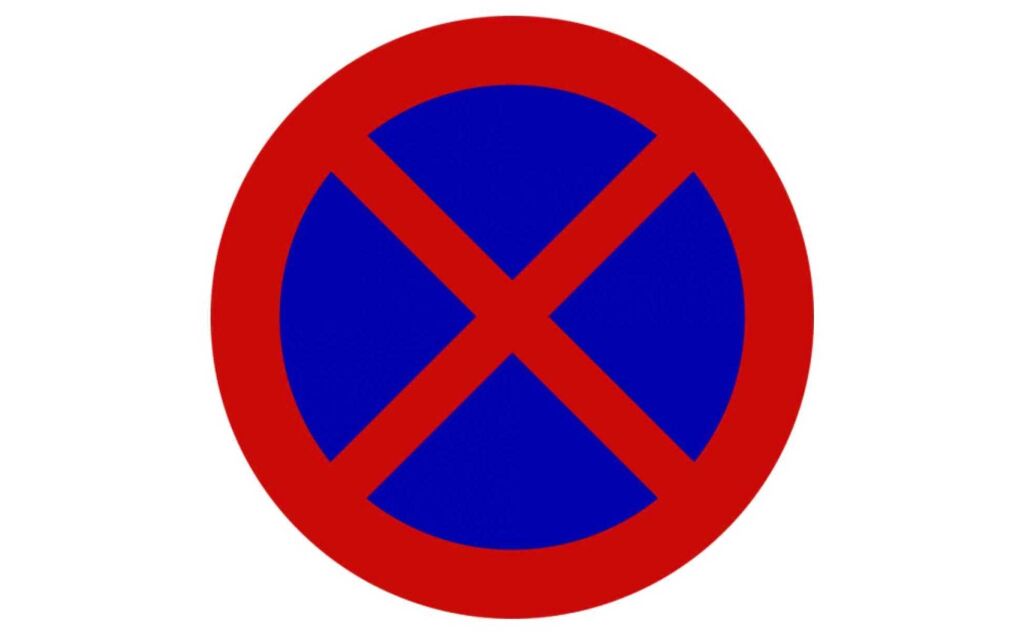
One of the most common reasons for fines and potential plate removal is the disregard for the P40 sign (Π-40). This sign is in the shape of a blue circle with a red border and two crossed red lines (shaped like an “X”).
- Meaning of the sign: The P40 sign indicates a strict ban on parking and stopping of vehicles.
- How long does the ban last? It is valid from where it is placed until the next intersection or until the next sign that cancels the ban.
- Which side of the road does it apply to? The sign is valid only for the side of the road on which it is located. If it is placed on the right side, it applies to the right side of the road. If it is placed on both sides of the street, parking and stopping are prohibited on both sides.
What is the penalty for improper parking at the P40 sign?
- Basic fine: For violating the P40 sign, the fine usually ranges from 40 to 150 euros, depending on the location and whether the vehicle obstructs the normal flow of traffic.
- Violations in narrow streets: If a vehicle blocks the passage of a bus, truck, or emergency vehicles, in addition to a fine, the police often resort to removing the plates.
Procedure for returning confiscated driver’s license and plates
When the traffic police confiscate a driver’s license or license plates from a foreign national, the documents are taken to the relevant traffic police station (Trochaja).
- Where are the documents kept? The documents are kept by the competent traffic police service for a specified period of time.
- How to retrieve the documents? Once the penalty period has elapsed (or in certain situations after paying the fine and providing proof of length of stay/arrangement), the driver personally retrieves the documents and plates at the police station.
- What if you do not retrieve the documents on time? If the owner fails to appear to retrieve the driver’s license by the end of their stay, the traffic police will officially redirect the documents through the Ministry of Transport to the consular authority (embassy or consulate) of the driver’s country of origin.
Who enforces and issues fines in Greece?
Two services are responsible for enforcing the law and monitoring parking in Greek resorts:
- Traffic police (Trochaja / Τροχαία)
- Local municipal police (Municipal Police / Δημοτική Αστυνομία)
As they ensure smooth traffic flow in the summer season, inspections are frequent, so drivers are advised to leave their vehicles only in designated parking areas.


