











Since June 18, 2026, new rules for the complete first aid kit in vehicles come into force in Greece. The kit has been mandatory up to now, but for the first time, its content, technical specifications, and method of use are precisely prescribed.
For drivers from Serbia, this is not essentially something new. The first aid kit is mandatory equipment in our country as well, with clearly defined and very high standards. In Greece, there has always been an obligation for a first aid kit in the car, but now the content is being standardized and greater emphasis is placed on its correctness and readiness for use.
Until now, it has been sufficient for the kit to exist. The new rules introduce the obligation for it to be precisely defined, complete, and in good condition.
The regulation applies to all road motor vehicles except two-wheelers.
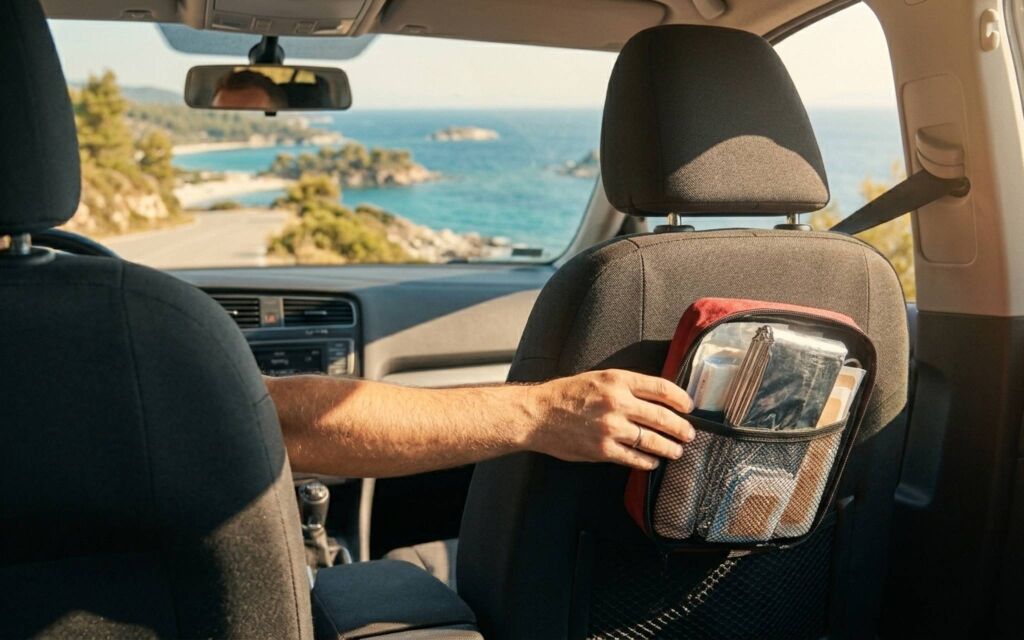
The kit must be located in an easily accessible place in the vehicle, it must not be locked, and it must contain nothing but medical supplies. The responsibility for its condition lies with the driver or the vehicle owner, and it is recommended to regularly check and replenish it, especially due to high summer temperatures, no later than within two years. All materials must be within their expiration date, undamaged, and with the appropriate CE mark.
What the first aid kit must contain
- Rescue blanket (isothermal) (minimum dimensions: 210 x 160 cm – metallized)
- Roll of fixing tape (DIN 13019-A, 5 m x 2.5 cm)
- Set of adhesive plasters (DIN 13019-E, 14 pieces of various sizes)
- Individual sterile dressing (small) (DIN 13151-K, approximately 6 x 8 cm)
- Individual sterile dressing (medium) (DIN 13151-M, approximately 8 x 10 cm)
- Individual sterile dressing (large) (DIN 13151-G, approximately 10 x 12 cm)
- Sterile burn dressing/gauze (DIN 13152-BR, 60 x 80 cm)
- Wound dressings (compresses) (10 x 10 cm, pairs)
- Elastic adhesive bandage (narrow) (DIN 61634-FB, 6 cm x 4 m)
- Elastic adhesive bandage (wide) (DIN 61634-FB, 8 cm x 4 m)
- Triangular immobilization bandage (DIN 13168-D, 96 x 96 x 136 cm)
- First aid scissors (DIN 58279-A 145, trauma shears)
- Single-use medical gloves (DIN EN 455, vinyl/nitrile, large)
- Moist cleansing wipes
- Medical face mask (type IIR or FFP2)
- First aid instructions
The penalty for not having or having an inadequate kit is 30 euros, but the focus of the regulations is not on punishment, but on ensuring that the equipment in the vehicle can actually be used in emergencies.
The new rules do not introduce a new obligation, but a more precise standard - with the aim of making the first aid kit in the car truly useful when needed.
For Serbian drivers, this is not a significant change
Standard first aid kits in Serbia already contain most of the materials that are now precisely prescribed in Greece. The difference lies in a few additional elements and a stricter focus on correctness and availability in the vehicle. In practice, this means that before traveling, it is sufficient to check if the kit is complete, if all materials are within their expiration date, and to add three items such as:
- packaged adhesive plasters,
- protective masks, and
- moist cleansing wipes.
Also, although manufacturers often state a longer shelf life for the kit, high summer temperatures in the vehicle can affect the condition of the materials, so periodic checks are recommended, especially after long periods of standing.
How is it in other EU countries?
The situation in the EU varies, but in most countries, having a first aid kit in the vehicle is mandatory or considered standard equipment.
- Germany / Austria – mandatory, must comply with the DIN 13164 standard
- Czech Republic – mandatory, known for stricter enforcement in practice
- Croatia / Slovenia – mandatory, standards aligned with European norms
- France / Italy – rules vary, but the kit is generally considered standard equipment in practice and is often part of legal requirements
Crossing standards: what do you already have in your kit according to the Serbian standard? We present the official specification of the Serbian Type B kit. By comparing it with the new Greek regulations, it is clear that our car first aid kit is quite sufficient for most drivers. Check the list and verify your pouch:
Contents of the first aid kit in Serbia - Type B (SRPS Z.B2.001):
- First dressing – sterile, 10 cm x 5 m, with one pad 12 cm x 10 cm (2 pieces)
- Calico bandage – 10 cm x 5 m (2 pieces)
- Calico bandage – 8 cm x 5 m (2 pieces)
- Sterile gauze – 1⁄2 m, 80 cm x 50 cm, individually packed (2 pieces)
- Sterile gauze – 1 m, 80 cm x 100 cm, individually packed (1 piece)
- Sterile gauze compress – 10 cm x 10 cm, 12 layers, individually packed (5 pieces)
- Adhesive bandaging material – 10 cm x 8 cm (5 pieces)
- Adhesive plaster – 2.5 cm x 5 m, on a reel (1 piece)
- Triangular bandage – size 100 cm x 100 cm x 140 cm, cotton (2 pieces)
- Safety pins – at least 4 cm in length (6 pieces)
- Scissors – curved, with rounded tip, at least 12 cm in length (1 piece)
- PVC bag – small, 20 cm x 30 cm (1 piece)
- PVC bag – large, 40 cm x 60 cm (1 piece)
- Single-use PVC gloves (2 pairs)
- Isothermal blanket – at least 150 cm x 200 cm, for single use (1 piece)
- Device for artificial respiration – for single use (1 piece)
- Content specification of the kit (1 piece)
- First aid instruction (1 piece)
Note The first aid instructions are designed in collaboration with the Red Cross according to European guidelines.
*As a reminder, the Red Cross of Serbia is a leading expert in the world of first aid on European soil. For decades, they have been providing first aid training from schools to professionals (workers and drivers). We would especially like to highlight that the youth teams have been multiple champions in European first aid competitions and once in the world first aid competition.
The instructions you have in the box (designed according to European guidelines) are your most important ally. Before the trip, take 5 minutes to browse through it - knowledge is the only part of the equipment that doesn’t take up space in the car, yet is the most valuable.


