


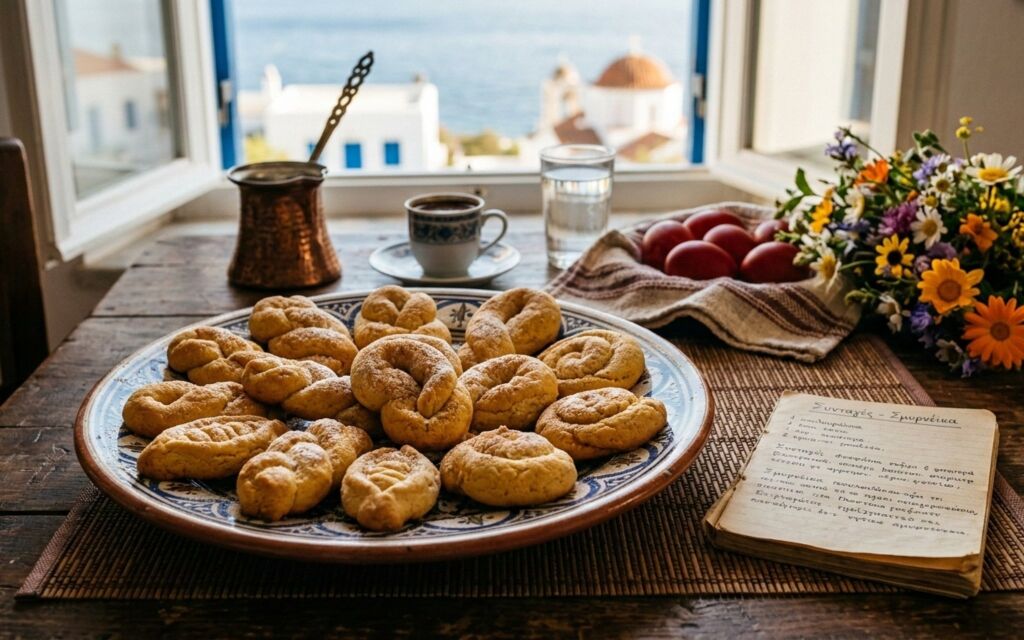
Some scents have the power to instantly take us back to childhood, while others transport us to a distant history. Smyrneika cookies are exactly that - a memory of Smyrna, the former home of hundreds of thousands of expelled Greeks, of old recipes kept in notebooks with yellowed pages, and of the warmth of home felt in every bite.
Today we share a recipe for these delicate, fragrant cookies that melt in your mouth. They may not be perfect in appearance, but they are the most beautiful in spirit. Who still remembers the smell of cinnamon from grandma’s kitchen?
The Appearance of Smyrneika Cookies
- Crunchy on the outside
- Soft on the inside
- Fragrant with a combination of butter, vanilla, and orange
- Often shaped as:
- Braids
- Spirals
- Little “boats”
Smyrneika Cookies - Ingredients (large and small quantities)
| Ingredient | Large Quantity (family recipe) | Small Quantity (½ measure) |
|---|---|---|
| Flour | 1250–1300 g | 620–650 g |
| Sugar | 500 g | 250 g |
| Butter | 500 g | 250 g |
| Baking powder | 20 g | 10 g |
| Orange juice | 110 ml | 55 ml |
| Sparkling water | 110 ml | 55 ml |
| Brandy | 60 ml | 30 ml |
| Vanilla | 2 packets of vanilla sugar | 1 packet of vanilla sugar |
| For brushing | 3 egg yolks + 3 tablespoons of water | 1 egg yolk + 1 tablespoon of water |
Note:
- All ingredients must be at room temperature.
- Add the ingredients one by one and slowly, while constantly stirring.
Dough Preparation
- Cream the butter with a mixer until it becomes light and fluffy.
- Add sugar and continue mixing for about 5 minutes, until the ingredients are well combined.
- Pour in orange juice, sparkling water, vanilla, and brandy, and briefly mix.
- In a separate bowl, combine flour and baking powder.
- Gradually add flour to the mixture while stirring constantly.
- When you have added about 1 kg of flour, check the texture of the dough. It should be elastic and soft, but not sticky. If it’s still sticky, add another around 100 g of flour and check again.
Handy tip:
In traditional Smyrneika cookie recipes, the amount of flour may vary slightly. The dough should be soft and elastic, but not sticky. The last 50–100 g of flour is often added gradually until the right texture is achieved.
The dough should be soft and just slightly sticky.
Shaping the Cookies
- Line a baking sheet with parchment paper.
- Take a small piece of dough.
- Roll it into a log about 20 cm long with your fingers.
- Then fold the log into the desired shape - most commonly spirals, braids, or little “boats” characteristic of Smyrneika cookies.
Feel free to shape them as you wish - the possibilities are endless.
Smyrneika cookies are best when left in a closed container for a day - they become even softer and more fragrant.
The Story behind the Cookies: Why are They Called Smyrneika
The name Smyrneika (σμυρνέικα) literally means “from Smyrna,” referring to the city of Smyrna - present-day Izmir in Turkey. These cookies originate from the Greek community that lived for centuries in Asia Minor and developed a rich and distinctive cuisine.
After the tragic events of 1922 and the population exchange between Greece and Turkey, thousands of Greek families from Smyrna moved to Greece. They brought with them the recipes of their cuisine, including these fragrant cookies. It was then that they began to be called Smyrneika - cookies from Smyrna in Greece.
Interestingly, in Smyrna itself, these cookies were simply called Easter cookies, as they were traditionally prepared during Holy Week before Orthodox Easter.
At that time, Greek cuisine was much simpler than it is today. Sugar was expensive and rarely used, so sweet pastries were not an everyday occurrence. It was the women from cosmopolitan Smyrna who brought a new baking culture to Greece - pastries rich in butter, sugar, vanilla, and the scent of citrus.
Today, Smyrneika cookies are a traditional sweet treat on the Greek Easter table, along with the traditional tsoureki bread and red-dyed Easter eggs.
How Old is This Recipe
As with most traditional dishes, the exact “first recipe” for Smyrneika cookies is not preserved. However:
- family recipes have existed for over 100 years
- in many families, they have been passed down for five generations
This suggests that the recipe originated in the late 19th or early 20th century in Smyrna, at a time when this city was one of the most important cultural and trading centers in the eastern Mediterranean.
Today, Smyrneika cookies are a tradition on the Greek Easter table, along with tsoureki bread and red-dyed Easter eggs.
After the midnight liturgy and celebrations, the Greek table is unimaginable without another important dish - magiritsa. Learn all about why magiritsa is the traditional soup after the midnight liturgy and how it is prepared see here.
If you plan to experience the holiday spirit in the city this year, you can read all about how Easter is celebrated in Thessaloniki and what to pay attention to regarding store hours.
Follow us on social media where we regularly share exclusive offers, discounts, and special packages for vacations in Greece, as well as information, advice, and useful news.
- Facebook: Nikana.gr
- Instagram: @nikana.gr
- Tiktok: nikana.gr
- Facebook group: Live from Greece
- YouTube channel: @NikanaTravel
- Email us at: nikana@nikana.gr
- Visit our website nikana.gr which is the leading source of information about Greece in the Balkans.


