












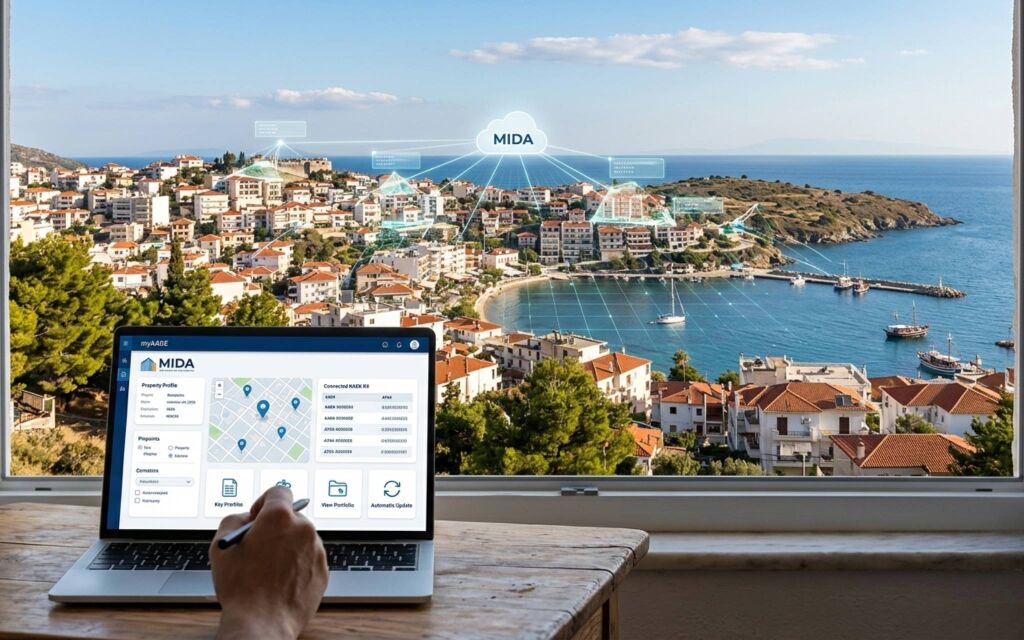
Greece has announced that one of the most ambitious digital tools to date will be launched in the first quarter of 2026 – the Real Estate Ownership and Management Registry, better known as MIDA (Μητρώο Ιδιοκτήρο Ιδιοκτήσης και ΗΣέμαρησης Ακινήτων). As of this writing at the end of April, the MIDA system has not yet begun its implementation, but most of the preparations, both legal and systemic, have been completed. The work is truly colossal, but also very important for Greece.
This system brings changes for both property owners in Greece and potential investors planning to buy property in Greece.
1. What does the MIDA system represent?
This system is set up as a central tool designed to merge data from two key sources:
- National Cadastre: Register where ownership deeds, precise parcel boundaries, as well as detailed data on apartments and buildings (KAEK number) are recorded.
- Tax Administration (AADE): Database of properties reported through the form E9 (ATAK number).
The goal of the system is to establish a unified, complete, and verified overview of property ownership throughout the country. The system is designed very ambitiously, but once established, it will provide a complete, comprehensive picture of properties and their ownership in Greece, not only that but also their purpose - whether it is primary residence, rental, abandoned houses, or commercial space. Through digitalization, all changes in ownership will be visible in real time, allowing the state to have an insight that corresponds to the actual situation.
2. Status and functionalities of the system
Although the legal framework has been established, the system is in the phase of gradual implementation. A digital dossier is planned for each property within the framework of Taxisnet.
- Integration of identification codes: Cross-referencing the property’s tax code (ATAK) with the cadastre number (KAEK) is used to create a unique “portfolio” - the identity of the property. This process ensures that each property has a unique digital footprint. In case of discrepancies, owners are obliged to make corrections.
- Third-party information: The law allows the Tax Administration to use data from external entities, such as the electricity distribution company (DEDDIE) or insurance companies. This data serves as an additional tool to obtain the most up-to-date information on the real status, usage, changes, etc.
- Digital property profile: Each property will have its digital profile with all documents (permits, certificates, ownership deeds…) “collected” in one place, which should significantly facilitate property transfers, inheritances, subsidies, or investments in real estate in the future. The system is expected to significantly streamline and simplify procedures.
3. Benefits for owners and investors
Although this system introduces stricter control, it also brings significant benefits for owners and potential buyers:
- Unified overview: Owners will have a display of their entire property portfolio in one place, making it easier to make decisions about property management.
- Automatic updates: It is planned that the data in the system will be automatically refreshed after each sale or inheritance procedure. This provides security for investors as they have insight into the current and clear status of the property.
- Digital management: Digitalization reduces administrative burden, allowing for the submission of statements or corrections without physically visiting Greek authorities.
4. Strategic goals (According to official statements)
As highlighted in official statements from the Ministry of National Economy and Finance, the key priorities of this registry are:
- Combating tax evasion: Focus on complete transparency of income, especially in the rental sector.
- Support for social policy: Obtaining reliable data for planning housing policy and fairer taxation.
- Market improvement: Reducing bureaucracy and speeding up the buying and selling process through digital data verification.
Recommendation for owners
Considering that the MIDA system is in the phase of gradual implementation, owners are advised to, during regular consultations with their accountant in Greece, check if any data adjustments are necessary. Your accountant will best assess whether the ATAK and KAEK numbers of your property are correctly recorded in the system, so you are prepared for the moment when the platform becomes fully operational.
If you are just considering an investment, check out a detailed article on experiences of our people who have recently bought property in Greece.
This text is for informational purposes and is based on available legal acts and reports from expert portals (Taxheaven, AADE) up to April 2026.


