



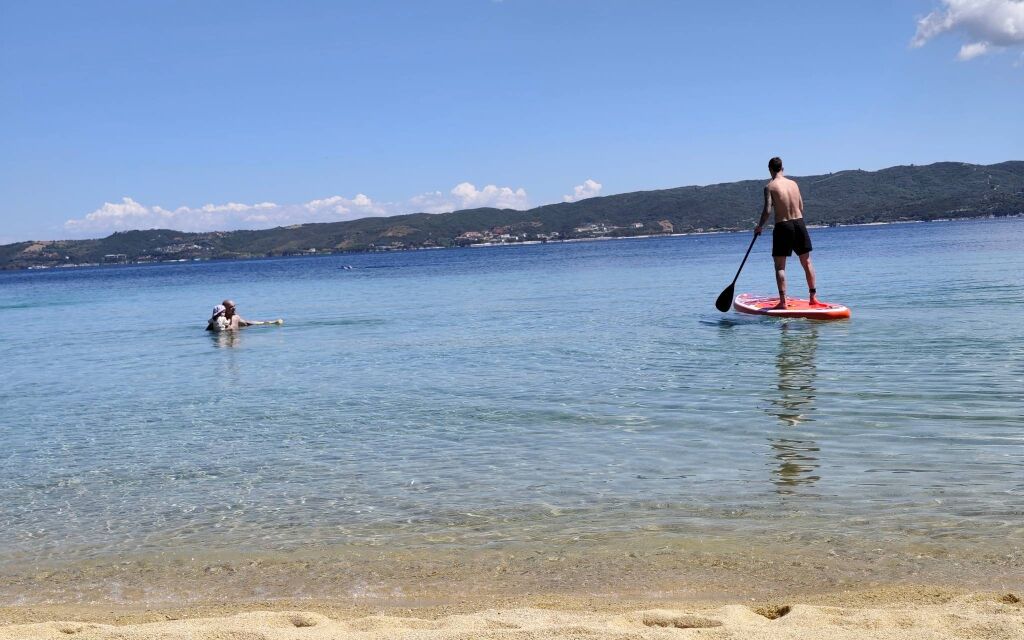
Paddleboarding or paddling has become a hit on the beaches in Greece, and here you can read the rules that must be followed when riding. In addition to the rules, there is also a step-by-step guide on how to get on the board and master this skill.
There have been cases where sea currents have taken people on SUP boards far from the shore, where they are in a situation where they cannot return and cannot call for help. Also, there have been situations where board riders have hit other swimmers.
- While we consider our good swimming knowledge to be sufficient guarantee, the power of the sea must not be underestimated - safety must always come first.
Rules for SUP Boarding
Greek legislation (ΑΔΑ: Β49ΖΙ-Ο8Ρ, ΦΕΚ Β 6543⁄21.12.2022) prescribes specific rules for the safe use of SUP boards:
- Mandatory use of life jackets by every individual using a SUP board.
- It is prohibited for individuals who do not know how to swim to use a SUP board.
- Minors under the age of 14 are not allowed to use a SUP board.
- More than one person is not allowed on a SUP board.
- An individual using a SUP board must not move more than 500 meters away from the shore.
- The use of a SUP board is only allowed during the day.
- It is prohibited to use a SUP board when unfavorable weather conditions prevail at sea.
- An individual using a SUP board must move in a way that does not disturb or endanger other swimmers.
It is not difficult to comply with these rules, and the enjoyment on the SUP board is a reward for anyone who has mastered this skill. Although it looks easy to stand and glide on the surface of the sea, behind it lies the skill of balancing and maintaining equilibrium that needs to be mastered.
Is there a fine to pay?
The fine for not following these rules is 250 euros and is not negligible at all. This fine is most commonly imposed for not wearing the mandatory life jacket, but according to the law, it can also be applied for other offenses such as riding a SUP board at night, moving too far from the shore (more than 500 meters), or riding with more people on a board not intended for that purpose (so-called tandem boards).
And now, take a look at the steps and tricks on how to master the SUP board.
How to Get on a SUP Board: Step-by-Step Beginner’s Guide
Let’s get down to business. Let’s forget about the people who look like they were born on a board on Instagram - they all started in shallow water, struggling to maintain balance. To avoid wasting energy constantly falling into the water, follow these instructions, and we believe you will go through without muscle strain (and without too much laughter from the shore!).
Step 1: Preparation and board positioning
Start in water up to your thighs or waist:
- Never try to climb onto the board while in very shallow water or on the sand, as you will break or damage the fin located on the underside.
- Enter the water deep enough for the board to float freely next to you.
Position the board towards open water:
- The bow of the board should always be facing out to sea, not sideways to the waves. This way, you will cut through the water more easily and prevent small waves from shallows from immediately turning you over.
Step 2: First contact and stability
Lean on the board with your hands: Holding the paddle in your hands (or place it vertically in front of you), firmly lean on the board with your palms. First lay on your stomach:
- This is a trick that many skip, but it’s actually a lifesaver for beginners! Instead of trying to kneel immediately, just lie on your stomach on the board. The lying position gives you maximum stability and gives you the chance to feel how the board reacts to the water under your weight.
Step 3: Transition to kneeling
Move to your knees (and sit on your heels):
- From the lying position, slowly rise to your knees, but sit on your heels. Your knees should be placed on either side of the central handle on the board (that handle is your “center of the world” and marks the point of ideal balance).
Paddle a bit in this position:
- Don’t rush to stand up! Stay in a low position and take a few strokes. This way, you will feel how the board reacts to the wind and your movements, and your center of balance is still low and completely safe.
Then on your knees - but without sitting:
- When you feel more confident, straighten your upper body so that you are no longer sitting on your heels, but kneeling upright. Paddle a few meters again to find a new balance.
Step 4: Rising to a standing position
- Only when you feel the board is stable, slowly stand up: When you feel the board is still and you are in control, it’s time to stand up.
Lift one leg at a time:
- While still keeping your hands supported on the board in front of you, slowly lift one knee and place your foot on the board (right where your knee was a moment ago). Then do the same with the other leg. Gently push off with your hands and straighten your knees.
Golden balance trick: Look at the horizon!
This is rule number one that saves you from falling:
- never look at your feet or the board! As soon as you look down, your body automatically loses balance and you will start to lean.
- Raise your head, straighten your back, and look straight ahead towards the open sea.
- Looking into the distance keeps you stable.
Experience tip: Don’t pay attention to the laughter from the beach and enjoy every attempt! Falling is part of the fun, and that feeling when you finally catch the rhythm and start gliding on the water is worth every funny fall in the shallows.
We wish you calm seas and lots of enjoyment!
Planning a vacation in Greece?
On the website Nikana.gr you can find detailed guides, useful information, and a wide selection of accommodations for Halkidiki and the rest of Greece. For internet in Greece, the Nikana eSIM card is available. Follow us on social media where we regularly share current information, tips, and tourist experiences.
- Facebook: Nikana.gr
- Instagram: @nikana.gr
- Tiktok: nikana.gr
- Facebook group: Live from Greece
- YouTube channel: @NikanaTravel
- Email us at: nikana@nikana.gr
- Visit our website nikana.gr, the leading source of information about Greece in the Balkans.


