












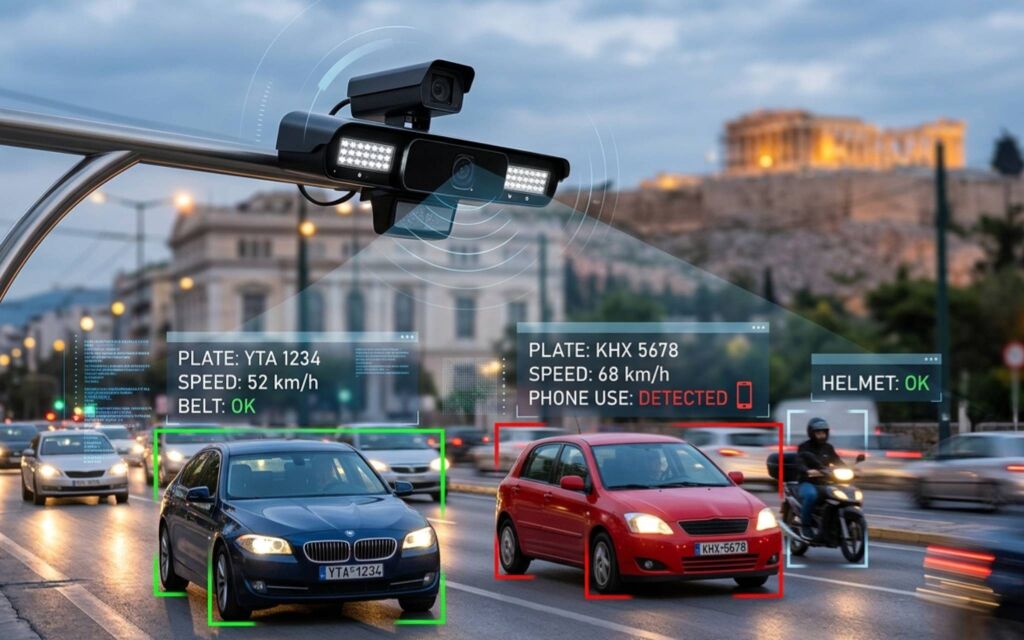
AI cameras in Greece - putting an end to “reckless” driving
Since March 28, 2026, AI cameras have started operating at 8 points and 10 buses in Athens, and by the end of the year they will begin in Thessaloniki and Crete, with an additional 2000 cameras. This is no longer a system that can be avoided. Control is now automated.
The AI cameras have already issued the first 150 fines - directly to the offenders. Without delay, through the digital system - automatically to the phone.
For example: if you run a red light in Athens, the camera records the license plate, the violation is processed automatically, and the fine is sent through the digital system in record time to your phone or email.
What is astonishing is that during just one month of testing in January, 40,000 serious violations were recorded. Even more shocking: just one camera (on Mesogeion avenue) recorded 28,000 instances of running a red light!
Official institutions emphasize
“The goal is not punishment for profit, but deterrence from dangerous behavior. We are not chasing someone driving 52 in a 50 zone, but those driving at 120 and endangering lives.”
It is emphasized that the goal of the cameras is to enforce the law and reduce the number of serious violations that endanger everyone’s safety. We must remind that Greece has been characterized as a less safe country for driving, and this system will impact the overall safety in traffic as well as the reputation of the entire state.
What do AI cameras capture?
Unlike existing cameras installed on the Attica Odos highway and other locations, which only record speeding and running red lights, new AI cameras also capture driver behavior:
- Failure to wear a seatbelt in the vehicle;
- Not wearing a helmet on a motorcycle;
- Driving in the yellow lane (the cameras distinguish when a driver is in the yellow lane to turn onto a side street and when not);
- Using a mobile phone while driving (texting and talking on the phone while holding it).
These rules are not unknown, and we have written about them before, so you can refresh your memory here:
Every violation now leaves a digital trace that cannot be erased.
What does the new AI camera recognize and record?
The AI camera recognizes:
- the vehicle’s license plate,
- make,
- model,
- and color of the vehicle.
Further use of the collected data pertains to Greek citizens, not tourists.
- Authorities can use the collected data to check if the vehicle is insured, has passed a technical inspection, and has any unpaid fines or tolls.
Where are the cameras located now and where are new ones planned to be installed?
By summer, the installation of new 1000 AI cameras is expected. They are currently being installed in Athens, but the plan is to cover Thessaloniki and Crete by the end of the year.
Locations of AI cameras in Attica
- Athens: Intersection of Panepistimiou and Vasilissis Sofias.
- Agia Paraskevi: Mesogeion and Chalandriou.
- Rafina-Pikermi: Maratona and Fleming.
- Kallithea: Syngrou and Agias Fotinis.
- Elliniko-Argyroupoli: Vouliagmenis and Tinou.
- Filothei-Psychiko: Kifisias and Ethnikis Antistaseos.
10 cameras have been installed on buses to monitor the misuse of the yellow lane reserved for urban traffic.
How are fines issued?
The system is designed for drivers to receive immediate notification directly through the Gov.gr Wallet application, SMS, or email. There is a state contact registry (EMEP) and 65-70% of Greeks have their contact details registered in it.
For those who do not have data in EMEP, the fine will be sent traditionally by mail or email. However, compared to the previous process of sending and collecting fines that lasted for years, this is an exceptional reduction in time, from around 3 years to a few minutes.
What is the deadline for appeal and payment?
- Everyone who receives a fine for a violation has 13 days to file an appeal. (Under Greek law, the 3-day appeal period begins 10 days after receiving the fine, totaling 13 days.)
- The appeal is also submitted digitally, via email.
- The fine must be paid within 8 months.
What if the fine is not paid?
For Greek citizens, this is not good news for those who do not pay the fine. The digital payment system ODISEAS sends the case to the tax administration (AADE) for forced collection in accordance with the Law on Public Revenue Collection.
Everything is digitized, practically preventing fines from being “erased” without cause.
Future plans - installation of another 2,500 cameras
By the end of 2026, the plan is to cover Athens and Thessaloniki at the most critical points, the so-called high-risk areas identified by the traffic police.
- From 2027, expansion will continue to other parts of Greece.
- Municipalities and regions can independently connect to the existing system if they wish and invest in this system.
- 500 buses (OSY) will be equipped with cameras to monitor violations in the yellow lanes,
- Additionally, in Attica (region), an additional 388 new cameras will be installed to also record the rear of vehicles, i.e., capture the rear license plates when vehicles pass a red light.
Important for tourists
There is no official information yet on how fines will be delivered to foreign drivers. If you rent a vehicle, it will be registered immediately and sent to the agency.
However, since the system recognizes license plates and automatically records violations, the data remains permanently recorded. There is no official confirmation yet that fines will be automatically collected at the border. The scenario for fine collection usually develops in three directions:
- System registration: The fine remains linked to your data and can await you upon your next entry into Greece.
- EU registry: Violation data within the Union is interconnected, which can create a problem at any entry into the EU.
- Private collections: Greek authorities increasingly engage law firms that collect fines (with high procedural costs) directly at your home address.
We have explained this in more detail in the text here: Traffic regulations in Greece where the offense registry is located and where you can check your status.
Our advice: Do not risk additional interest and inconvenience at the border. As there is also an international data exchange, we advise you to always pay fines.
In practice, this means one thing: driving in Greece enters a new phase - where violations are no longer forgotten and do not expire.
We hope these measures will contribute to the safety of traffic in Greece, which has a very “bad reputation”.
If you are traveling by car, we hope for safer driving for everyone. Respect the rules!


