


Before introducing you to this folk custom in Greece, we must mention that the holidays last for a full twelve days, from Christmas on December 25th, through New Year’s, i.e. Saint Basil’s Day, to Epiphany on January 6th.
For more detailed information about the history and significance of these holidays in Greece, please see Why does Greece celebrate Christmas on December 25th
What are Kalanda - Greek Carols and When Are They Sung
Kalanda (carols) are folk greeting and praise songs traditionally sung every year before major religious holidays such as Christmas, New Year (Saint Basil), and Epiphany.
The origin of this custom dates back to ancient times - thousands of years ago, has a multi-layered history, and is interpreted in two ways.
1. Ancient Greek Origin Some historians emphasize that the tradition of singing holiday songs in Greece dates back to the ancient period. More precisely, ancient inscriptions similar to today’s songs have been discovered. These rituals were often associated with the god Dionysus and symbolized the awakening of nature and the coming of the new year. Children at that time used to carry a small boat, symbolizing the arrival of the god Dionysus. Sometimes they held olive or laurel branches in their hands, to which they attached red and white threads.
2. Connection with the Roman Calendar Other sources state that the name “kalanda” comes from the Latin word calendae, which designated the first days of the month in the Roman Empire. According to this interpretation, the custom of singing songs before the beginning of a new time cycle was transferred from Roman tradition and later integrated into Greek Christian holidays, giving it a religious content. In any case, regardless of the precise origin, kalanda remains an important and recognizable part of Greek holiday tradition that has survived to this day. Source
A characteristic point is the language in which they are sung today - katarevusa, which indicates their direct origin from the Byzantine period.
How the Custom Is Practiced Today
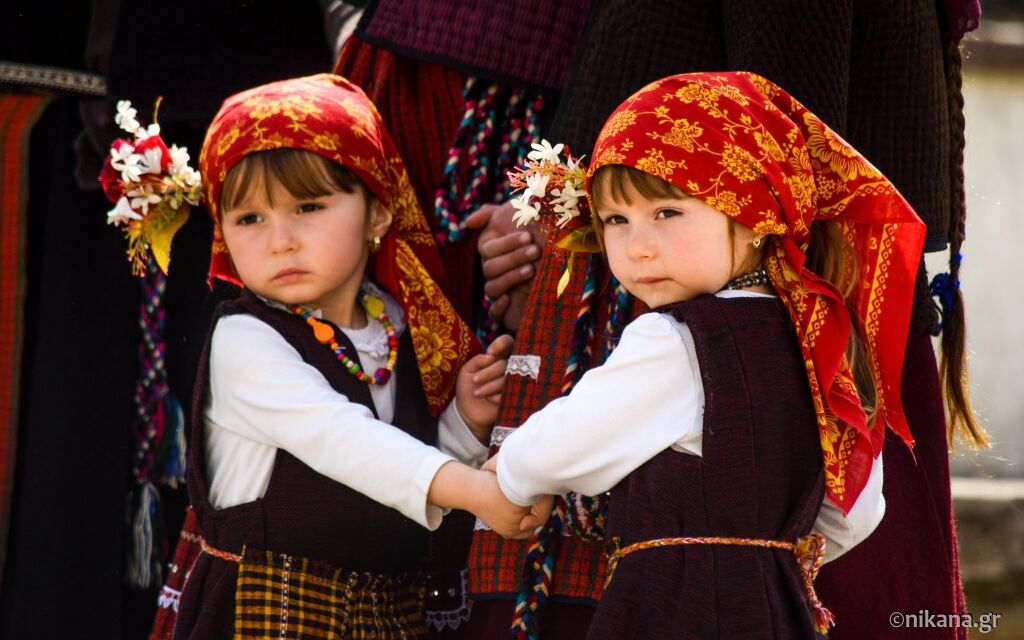
Kalanda are mainly sung by children up to 14-15 years old, but also by adults (mostly men), individually or in groups, who visit homes, shops, and public places accompanied by a traditional iron triangle, and sometimes by an accordion or drum.
On Christmas Eve, before New Year’s, and before Epiphany, children (and sometimes adults) in the early morning hours go from house to house, carrying a triangle (metal instrument), sometimes a small drum or bell, and sing kalanda to the hosts. The hosts reward them with sweets, dried fruits, cakes, or coins.
In some parts of Greece, the custom has remained almost unchanged, while in large cities it is mostly associated with children and school groups.
In the village of Naousa, a grandmother says: “As soon as I hear the first sound of the triangle, I know that the holidays are coming and my heart fills with joy.” Knowing that children are coming to her door to wish her a Merry Christmas.
Gift-Giving and Holiday Cakes Are an Important Part of This Custom
Original: Τρίγωνα κάλαντα σκόρπισαν παντού κάθε σπίτι μια φωλιά του μικρού Χριστού… Translation: “Triangles, songs, scattered everywhere, every home like a nest of the little Christ…”
The main purpose of these songs is to wish happiness, progress, and announce an important holiday. After the wishes of “Merry holiday,” the hosts would reward the singers - announcers of the happy holiday - of the birth of Christ or Epiphany.
In this context, kulurakia are prepared, small cakes - for Christmas these are melomakarona and kurabiedes. Whether bought at a bakery (which are full of these cakes) or made by housewives, every home in Greece has these cakes on the table for Christmas and New Year’s. The smell of cinnamon and honey spreads all over Greece, creating a festive atmosphere.
In stores in Greece, large quantities of bulk candies can be seen before the holidays, which hosts buy precisely for that reason, to distribute to children.
Structure of the Songs and Language
The songs usually start with a greeting, then announce the upcoming major Christian holiday, and end with wishes.
Example 1 — Christmas Carol (Kalanta Christougenon)
Original Greek text: Καλήν εσπέραν άρχοντες κι αν είναι ορισμός σας Χριστού τη Θείαν Γέννησιν να πω στ’ αρχοντικό σας. Translation:
“Good evening, gentlemen, if you please, Let me tell you about the Divine Birth of Christ in your noble house.”
It continues with wishes for happiness and well-being to the household.
This beginning is a classic introduction to many Christmas carols and is often the first sentence children sing as they enter homes. with wishes for happiness and well-being to the household.
Example 2 — New Year’s Carol (Kalanta of the New Year)
Original Greek text: Αρχιμηνιά κι αρχιχρονιά ψηλή μου δεντρολιβανιά κι αρχή καλός μας χρόνος… Translation:
“First day of the month and year, my tall rosemary, and may this year start well for us…”
It continues with expressions of wishes for the new year to be good and happy. This carol is traditionally sung around New Year’s (for Saint Basil’s Day), with wishes for happiness, health, and prosperity.
Various Variants of Kalanda
In Greek tradition, there are three main types:
- Christmas kalanda – sung on Christmas Eve and talk about Christ’s birth, Bethlehem, the Virgin Mary, and the shepherds.
- New Year’s kalanda – related to Saint Basil and the arrival of the New Year.
- Epiphany kalanda – sung before Epiphany and refer to the baptism of Christ and the blessing of waters.
Each of these songs has a different text, similar structure, and melodic quality, but they all convey the same message.
They can be divided into:
- national
- urban and rural
- traditional (by regions)
More than thirty variations have been counted in Christmas kalanda alone in Greece. Some regional differencesKalanda vary from region to region:
- on the islands of the Aegean Sea, they are often more melodious and slower,
- in northern Greece, more rhythmic and shorter,
- in Crete, they are sung with a local musical expression and sometimes with traditional instruments.
The texts are adapted to local customs, but all of them contain blessings for the household, health, and family prosperity.
Today, in addition to the mentioned ones, various Anglo-Saxon Christmas songs (Christmas Carols) have been introduced, some of which have been translated into Greek, which unfortunately tend to overshadow the traditional ones.
Kalanda Today – a Living Tradition
Although the way of life has changed, kalanda still hold an important place in Greek culture. They can be heard:
- in homes,
- in squares,
- in schools,
- on the radio and television during the holidays.
They are not just a folkloric decoration, but a living custom that connects the past and the present, religion and community, children and family.
If you want to find out what is traditionally found on the Christmas and New Year’s table throughout Greece, as well as which dishes and desserts are an essential part of holiday customs, take a look at the detailed guide: Christmas table in Greece - traditional dishes, desserts and holiday customs
We are always here to help you explore Greece! Follow us for the latest information, useful tips, and authentic experiences to make your holiday in Greece unforgettable!
We offer over 3,000 accommodations. Choose the one that suits you and your family by clicking HERE.
+
Internet as soon as you cross the border
You can have Internet as soon as you cross the border by purchasing our Nikana eSIM card here: https://nikana-esim.com/ Setting up is very simple, via a barcode in a few seconds you will have internet on your phone for any country in the world. Detailed instructions, how to check if your phone supports eSIM and answers to all questions can be found here: Nikana ESIM internet
Follow us on social media where we regularly share exclusive offers, discounts, and special holiday packages for Greece, as well as information, tips, and useful news. Facebook: Nikana.gr Instagram: @nikana.gr Tiktok: nikana.gr Facebook group: Live from Greece YouTube channel @NikanaTravel Email us at: nikana@nikana.gr Visit our website nikana.gr, the leading source of information about Greece in the Balkans.


