



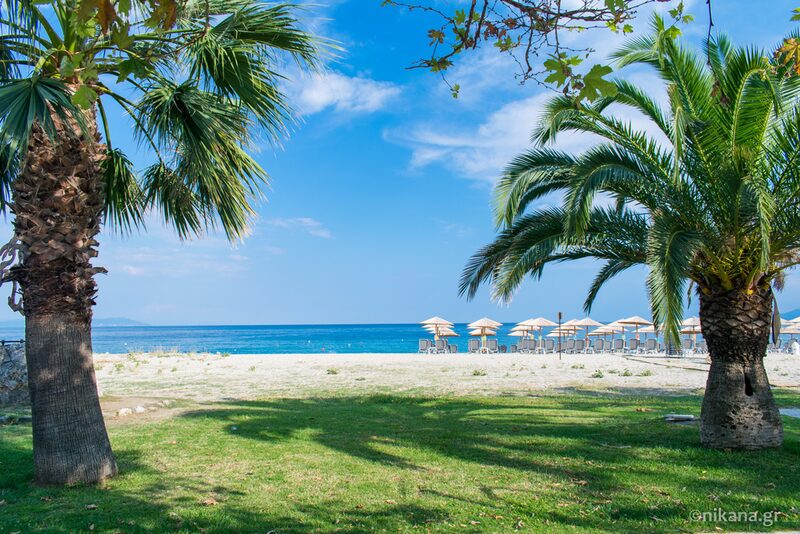

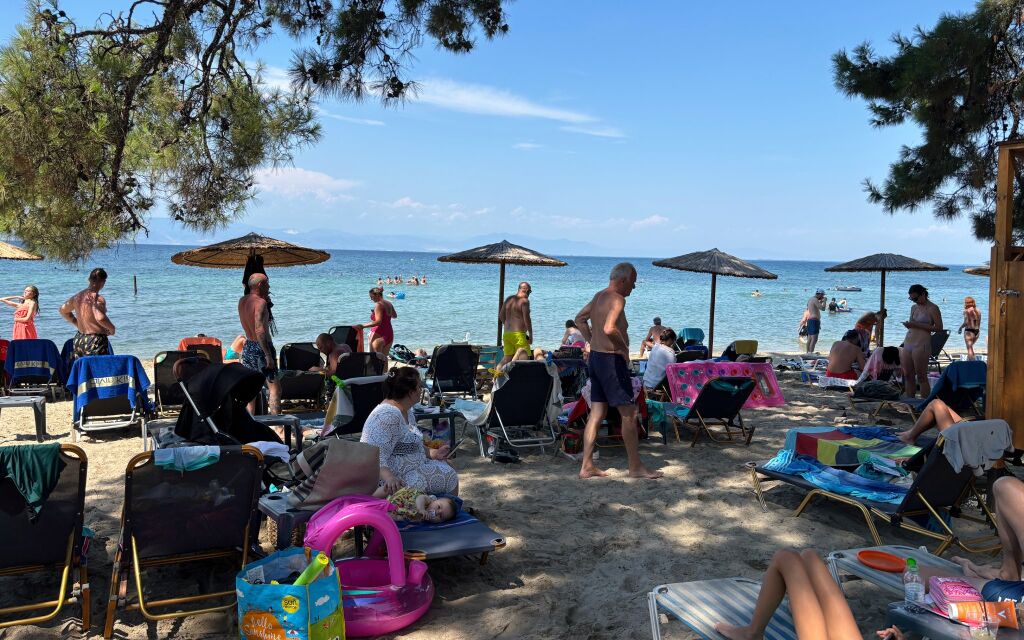
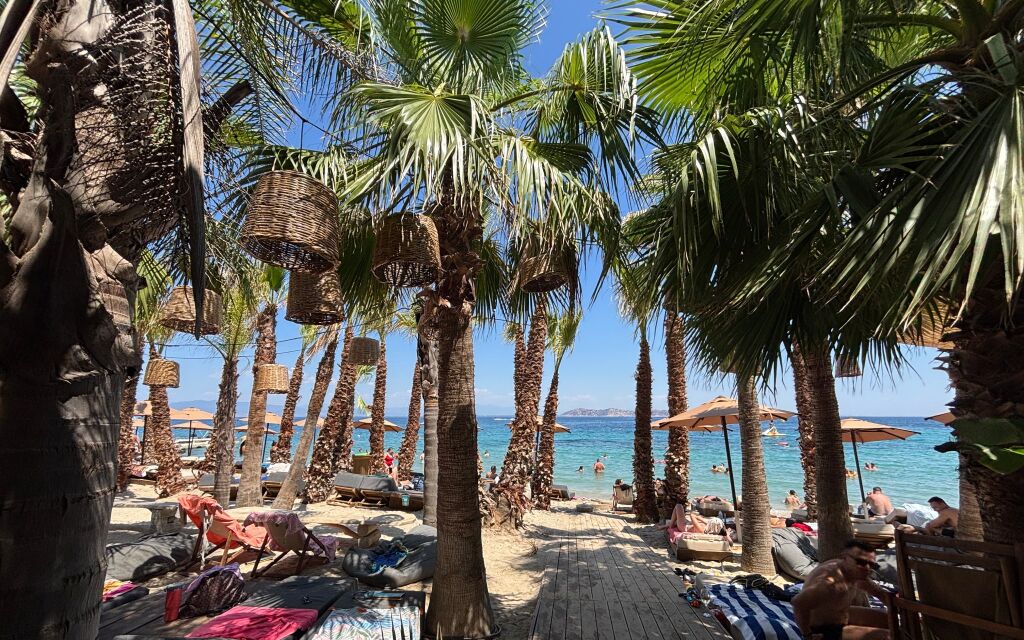
Vacationing in Greece can be perfect — but the sun in the Mediterranean does not forgive mistakes, especially when it comes to babies and young children. The good news is that you don’t need a “thousand rules” and ten different products, just a couple of clear habits that dermatologists and health institutions constantly emphasize: shade + clothing + smart beach time + proper application of sunscreen.
The World Health Organization emphasizes that protection is best achieved by staying in the shade and wearing clothing, and that sunscreens serve as a supplement for areas of the skin that are not covered.
Below you will find everything explained simply: which beaches to choose, what SPF means, mineral or chemical sunscreens, rules for application, clothing and sunglasses, what to do in case of sunburn, what to bring from Serbia, and what to buy in Greek pharmacies.
1) First rule: plan your beach time according to the UV index, not just how it feels
The sun can be dangerous even when it doesn’t seem strong. The wind cools the skin, so you may feel comfortable, but UV rays still have the same effect — that’s why people are often surprised by sunburns when it’s cool outside.
Practical rule for families:
- The strongest sun is usually from 10 am to 4 pm (WHO recommends limiting exposure during this period).
- If the UV index is 3 or higher, serious protection is needed (shade, clothing, sunscreen, sunglasses).
- For babies and young children, it’s ideal to go to the beach early in the morning and late in the afternoon.
2) Choosing beaches (families + children): shade is a luxury that changes everything
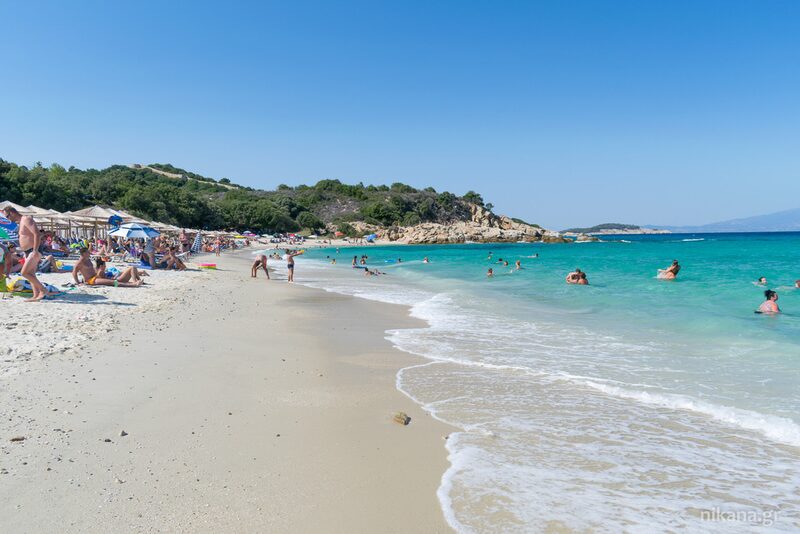
If you are vacationing with children, choose beaches that have:
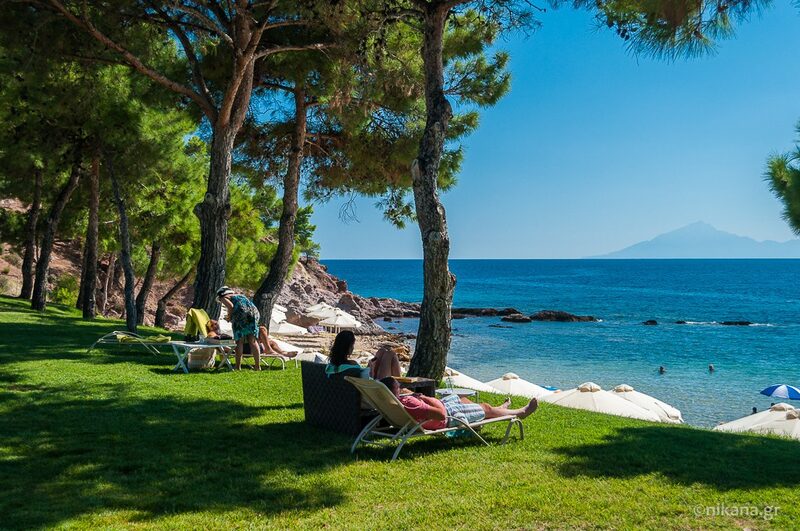
- natural shade (pines, trees)
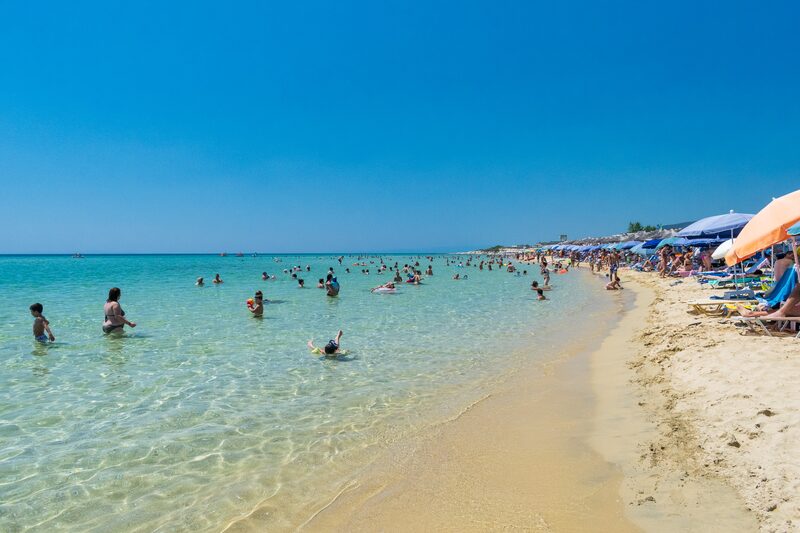
- a long shallow area
- a gradual entry into the water
- the possibility to seek shelter when the sun is strong
Important: beaches with natural shade are often the most sought after and fill up quickly, so:
- arrive early (the best spots in the shade are taken early)
- inquire before departure where there is shade exactly
- if shade is crucial for you, choose accommodation near such a beach
Articles on our portal:
- Beaches with natural shade in Greece
- Beaches with natural shade in Sithonia
- Vacationing with children in Kassandra
- Thassos: which place and beach to choose for vacationing with children
3) Is a beach umbrella enough protection?
A beach umbrella helps, but is not sufficient as the only protection:
- UV rays are partially reflected by sand and water
- UV can also come from the sides
Therefore, even in the shade, it is necessary to combine:
- protective clothing
- hat or cap
- sunglasses
- sunscreen for exposed areas
WHO emphasizes that sunscreens are not meant to prolong sun exposure, but to complement protection.
4) Can I “burn” in the water?
Yes — water is not a shield.
- Part of the UV rays still reach the skin
- The surface of the water further reflects light
That’s why sunburns are common in children who constantly splash around, while parents may think they are safe because they are in the water.
5) Clouds and wind: is there radiation when there is “no sun”?
- When it’s cloudy: UV can still be strong enough to damage the skin.
- When it’s windy: it doesn’t increase UV, but cools the skin which may lead to longer exposure and forgetting to reapply sunscreen.
6) UVA and UVB rays: which ones cause “burning” and which ones cause damage?
- UVB: causes redness and sunburn.
- UVA: penetrates deeper, contributes to skin aging and long-term damage.
Important: the absence of redness does not mean there is no skin damage.
7) What does SPF mean (simplest explanation)
SPF indicates how much sunscreen protects from UVB rays.
Two common misconceptions:
- SPF is not a license to stay longer in the sun.
- A higher SPF does not mean the sunscreen lasts longer.
For children: SPF 30 is usually recommended at least, and many choose SPF 50⁄50+ for added safety.
8) Mineral or chemical sunscreens: the difference
Mineral (physical) sunscreens
- Zinc oxide and/or titanium dioxide
- Stay on the skin’s surface and reflect UV rays
- Often recommended for babies and children
- Drawback: white residue, harder to spread
Chemical sunscreens
- UV filters that absorb rays into the skin
- Easier to spread, pleasant textures
- May cause irritation in sensitive skin
For the most conservative choice for young children: mineral, preferably non-nano sunscreen.
9) Nano particles: how to recognize them
In the EU, they are labeled as “nano” in the composition.
- Avoid “Zinc Oxide (nano)” and “Titanium Dioxide (nano)”
- Or choose products labeled “non-nano”
Special care is needed with sprays due to inhaling particles.
10) Spray or cream: what is better for children?
Safest:
- creams and lotions
If using a spray:
- do not spray directly on the face
- prevent inhalation
- always rub in the product
11) Rules of application: when, how much, and where mistakes are made
- Apply about 15 minutes before going out
- Reapply every 2 hours
- Always after swimming and towel drying
Most commonly forgotten areas: ears, neck, feet, hands, shins, scalp.
12) Should sunscreen be applied in the shade?
Yes — especially for children. Shade reduces, but does not eliminate UV radiation.
13) Babies and the beach
- Babies < 6 months: shade and clothing, minimal sunscreen
- Babies 6+ months: SPF 30+, regular reapplication
Exposure to the sun without protection is more harmful than applying sunscreen.
14) Preparing the skin for vacation
- hydration from within (water)
- external hydration (mild lotions)
- gradual exposure
15) Do sunscreens protect moles?
Partially. Moles are best protected with additional clothing and shade. Changes in moles should be checked by a dermatologist.
16) How to dress children at the beach
- UPF clothing
- denser weave
- shirts with sleeves
- wide-brimmed hat
17) Sunglasses
Choose:
- 100% UVA/UVB or UV400
- good fit to the face
- flexible frame for children
18) How long can we stay in the sun?
Don’t think in minutes. The rules are:
- avoid 10 am–4 pm
- shade + clothing
- reapply sunscreen every 2 hours
19) Expiry date of sunscreen
- Do not use after the expiration date
- If older than 3 years — discard
- Sunscreen that has been exposed to sunlight may be unreliable
20) Dermatologist’s advice (concise)
- Don’t rely solely on sunscreen
- Reapply regularly
- Choose broad-spectrum UVA + UVB
- Monitor the UV index
21) What to do in case of sunburn or sunburn
Immediately:
- get out of the sun
- cool shower or compresses
- hydration
- aloe vera or panthenol
Doctor should be consulted if:
- there are blisters
- the child has a fever, nausea, dizziness
- it concerns a baby or young child
22) What to bring from Serbia
- Panthenol (foam or cream)
- Bepanthen / Bepanthol
- Aloe vera gel (alcohol-free)
- Mild hydrating lotion
23) What to buy in Greek pharmacies
- After-sun gels with aloe and panthenol
- Bepanthol
- Soothing creams for irritated skin
24) “Home remedies”: what works and what doesn’t
Works:
- cold compresses
- lukewarm/cold shower
- oatmeal compresses
- hydration and light clothing
With caution:
- chamomile
- thermal water
- aloe from the plant
Do not use:
- yogurt, sour milk
- vinegar, lemon, alcohol
- oils and fatty layers on hot skin
- scented products
25) Mini checklist for the beach
Before going out:
- apply sunscreen generously
- hat and shirt
- water and snacks
- plan to return from strong sun exposure
At the beach:
- seek shade whenever possible
- reapply sunscreen
- wear UV sunglasses
If you notice redness: immediately seek shade, shower, hydrate, and use a soothing product.
We are always here to help you explore Greece! Follow us for the latest information, useful tips, and authentic experiences to have an unforgettable holiday in Greece!
We offer over 3,000 accommodations. Choose the one that suits you and your family by clicking HERE.
+ You can have internet as soon as you cross the border by purchasing our card here: Nikana eSIM.
Follow us on social media where we regularly share exclusive offers, discounts, and special arrangements for holidays in Greece, as well as information, tips, and useful news. Facebook: Nikana.gr Instagram: @nikana.gr Tiktok: nikana.gr Facebook group: Live from Greece YouTube channel: @NikanaTravel Write to us via email: nikana@nikana.gr Visit our website nikana.gr for the leading source of information about Greece in the Balkans.


