


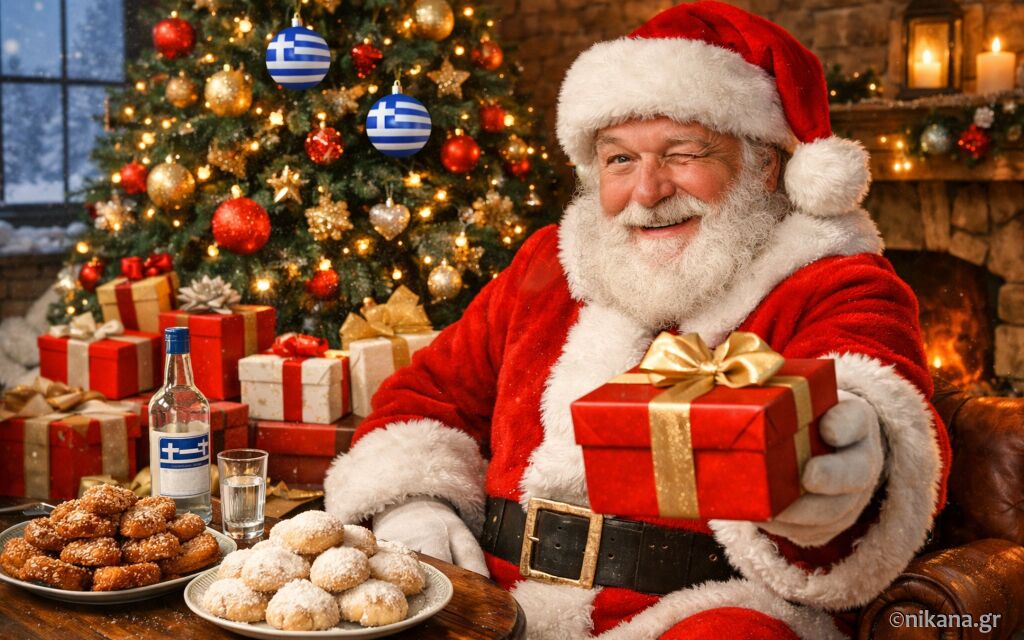
Unlike most of Europe and the world, where gifts are brought by Santa Claus on Christmas, in Greece it is done by Saint Basil - on January 1st\, a day that is both New Year’s Day and a church holiday.
This difference is not accidental - it is deeply rooted from the earliest days of Christianity and is tied to Saint Basil, one of the significant saints in Orthodoxy and in the memory of the Greeks.
Who was Saint Basil - a historical figure, not a legend
Saint Basil the Great (Gr. Agios Vasileios) was born around 330 A.D. in Cappadocia (modern-day Turkey), in a prominent and deeply Christian family. He was:
- the bishop of Caesarea,
- a theologian, writer, and reformer,
- but above all - a great benefactor, which is why he remained deeply engraved in the memory of the Greeks.
He is best known for his immense philanthropic complex known as the Vasilias - a kind of social center that included a hospital\, a shelter for the poor\, and a hostel for travelers. Source: Orthodox Synaxaristes
Why Saint Basil brings gifts
Gifts in Greek tradition are not associated with Christmas, but with New Year’s, as January 1st is celebrated as the day of Saint Basil. The reason is simple and deeply symbolic:
- Saint Basil secretly helped the poor during his lifetime,
- he generously gave money, food, and clothing,
- often unnoticeably, without expecting gratitude.
In popular consciousness, it is this discreet kindness that has become the basis of the custom of giving gifts, especially to children.
While the celebration of New Year is a modern custom, for centuries the Greeks have celebrated Saint Basil, who has remained in the people’s memory as a selfless giver and a symbol of kindness and sincere faith.
Saint Basil and the Western Santa Claus - similarities and differences
The Western Santa Claus originated from the legend of Saint Nicholas and European folk traditions, while Greece still celebrates Saint Basil, known for his philanthropy and humility. The main differences:
- Gift-giving date: Greece - January 1st, West - Christmas
- Appearance: Saint Basil - tall, dark hair and beard; Santa Claus - chubby, red and white suit
- Message: the same for both - kindness, solidarity, selfless and quiet giving.
Although today in Greece you can see the cute Santa Claus everywhere, the essence of the custom remains tied to Saint Basil.
Read more about how today’s character of Santa Claus was created, which also has roots in the saint Saint Nicholas who also lived in the 4th century.
New Year, Saint Basil, and vasilopita
The central custom for New Year in Greece is vasilopita - a New Year’s cake that contains a coin\, bringing luck to the one who finds it. The tradition is similar to our Christmas bread\, with roots tracing back to Saint Basil, a great benefactor and protector of the poor.
Families gather around the table of all generations, with a festive atmosphere: candles, smiles, anticipation of the coin, and sometimes fireworks.
The vasilopita is cut in a symbolic order:
- the first piece to Christ,
- the second to the house,
- the third to the poor,
- and the rest to the household and guests.
In smaller towns, the evening is intimate and family-oriented, while in larger cities, celebrations last in the squares with concerts and fireworks. However, vasilopita always remains at the heart of the holiday.
Saint Basil as part of the broader holiday tradition in modern Greece
Today, Saint Basil lives simultaneously:
- in church tradition,
- in family customs,
- Christmas carols, and
- in children’s joy of receiving gifts,
- integrated into the New Year’s Eve celebration celebrated by the whole planet.
That is why in Greece he is not just a “Greek Santa Claus”, but a moral symbol of the holiday.
In the twelve-day holiday period from Christmas Eve to Epiphany, Greece lives under the sign of:
- family gatherings,
- festive tables,
- traditional songs (kalanda),
- and a strong sense of unity.
This holiday period is preceded by a forty-day fast that starts on November 15th and ends on Christmas Eve.
Why Saint Basil is important today
In a time of fast holidays and consumer culture, Saint Basil reminds us of lasting values:
- quiet charity,
- caring for the weaker,
- the value of community.
Such examples exist today. One of them that we know of comes from the small seaside town of Plomari on the island of Lesbos. For years, an affluent citizen who wishes to remain anonymous has been donating money to a local store and butcher so that socially vulnerable fellow citizens can choose and buy groceries for the holiday table. This year, the amount intended for each family was 50 euros. This is just one example that is known. Many others we may never be aware of - and that is their essence. True acts of kindness do not seek attention but remain quiet and hidden.
Write to us if you also know a silent hero of today.
That is why in Greece, Saint Basil is not just a symbol of the holiday, but a living tradition passed down from generation to generation.
If you are planning to spend the holidays in Greece, check out the holiday program and attractions in Thessaloniki and Athens.
We are always here to help you explore Greece! Follow us for the latest information, useful tips, and authentic experiences to make your holiday in Greece unforgettable!
We offer over 3,000 accommodations. Choose the one that suits you and your family by clicking HERE.
+
Internet as soon as you cross the border
You can have Internet as soon as you cross the border by purchasing our Nikana eSIM card here: https://nikana-esim.com/ Setting up is very simple, via a barcode in a few seconds you will have internet on your phone for any country in the world. Detailed instructions, how to check if your phone supports eSIM and answers to all questions can be found here: Nikana ESIM internet
Follow us on social media where we regularly share exclusive offers, discounts, and special holiday packages for Greece, as well as information, tips, and useful news. Facebook: Nikana.gr Instagram: @nikana.gr Tiktok: nikana.gr Facebook group: Live from Greece YouTube channel @NikanaTravel Email us at: nikana@nikana.gr Visit our website nikana.gr, the leading source of information about Greece in the Balkans.


